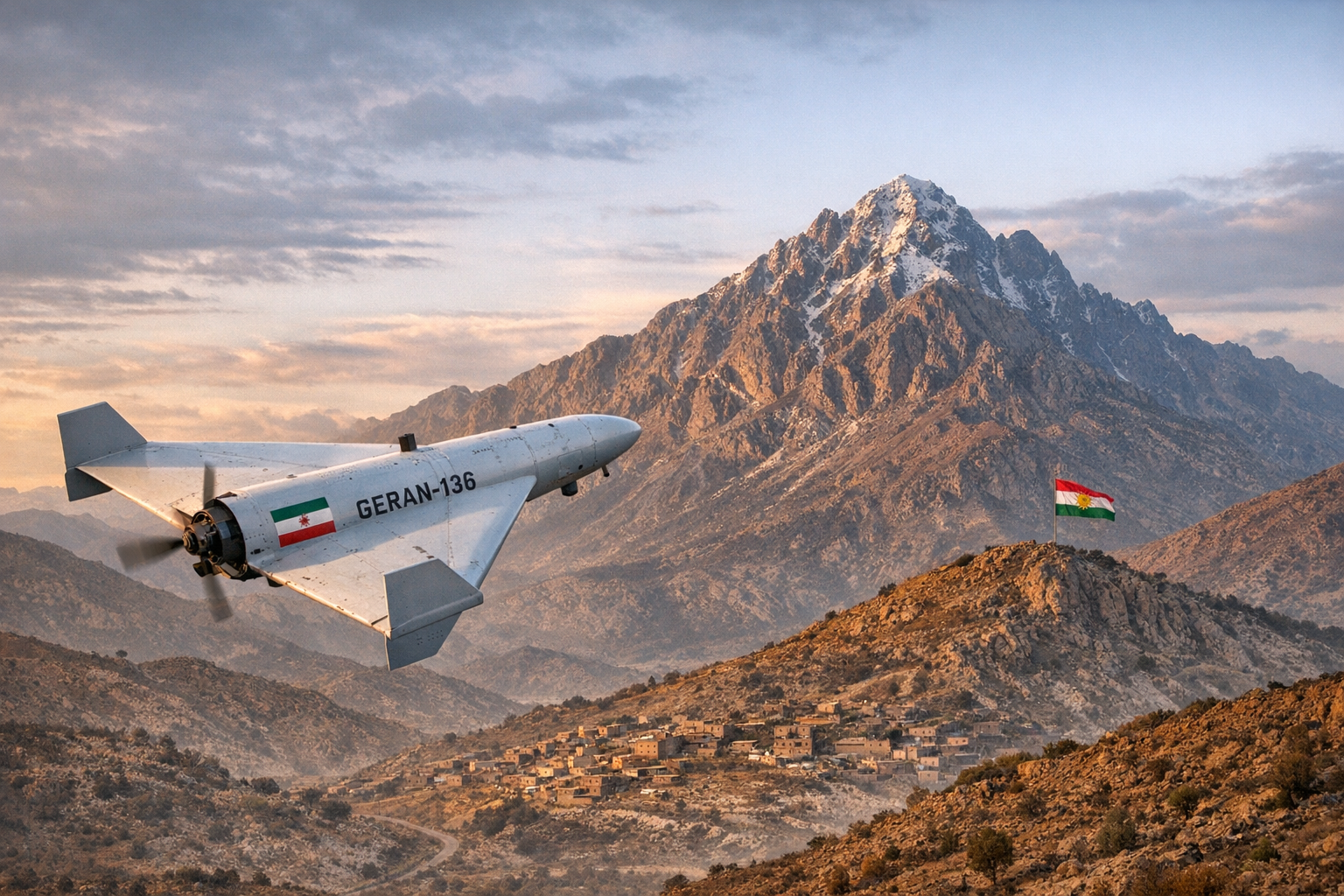
The US-Iran ceasefire that took effect on April 8 ended the large-scale Iranian missile and drone barrages against Gulf states. It did not end them against the Kurdistan Region of Iraq.
On April 9, a drone attack was reported over Erbil. On April 10, explosions were heard in Khalifan and Harir in Erbil governorate. On April 14, one-way attack drones hit three targets: a PDKI camp near Koya, and two Komala camps in Sulaymaniyah and Erbil governorates. Fighter jets intercepted additional drones. Two people were wounded, including Ghazal Mawlan, a young female Peshmerga from Mahabad serving with the Komala Party. She died of her injuries the following day.
On April 17, the attacks escalated again. The PDKI reported a drone strike on its civilian camp at Jezhnikan, near Bahrka, killing a child and injuring another person. In a separate strike on a PDKI camp at Sidekan, two female Peshmerga were killed. The party attributed both attacks directly to the Islamic Republic.
None of this is new. It is the continuation of a campaign that has run without interruption since February 28. Since the start of the Iran war, the Kurdistan Region has absorbed over 700 drone and missile attacks. The Hengaw Organisation for Human Rights documented at least 112 strikes on Kurdish party-linked sites by mid-March, across Sulaymaniyah, Koya, Degala, Bahrka, Soran, and Khabat. Targets have included not only military positions but residential buildings, a medical centre, and a library. In one incident in Soran, an IRGC drone struck the private home of a PDKI member inside an urban area — a shift from targeting fixed party camps to going after individuals.
The Khor Mor gas field, which supplies power stations across the Kurdistan Region, halted gas supplies in mid-April as a precaution against being targeted. The result was electricity blackouts across the region — a reminder that the effects of these strikes extend well beyond the party camps.
The KRG’s position throughout has been consistent and futile. It is not a party to this conflict. It has repeatedly condemned the strikes. President Nechirvan Barzani has called on Baghdad and the international community to intervene. The Peshmerga warned after the March 24 attack that killed six of its fighters in Soran that continued strikes “will not go unanswered.” But the federal Iraqi government lacks either the capability or the will to restrain Iran-backed groups operating from within its own territory. Foreign Minister Fuad Hussein acknowledged as much in a March interview, noting that the militias possess military, organisational, and parliamentary power.
The ceasefire between Washington and Tehran may be holding at the strategic level. At the level of a PDKI civilian camp near Bahrka, or a Komala position outside Sulaymaniyah, it does not exist. The CPFIK’s camps remain both too visible to hide and too exposed to defend — caught between a war that has paused and one that has not.